Planet - Neptune
Neptune
Mass :
1.0243×1026 kg
Distance from Sun : 4,503,000,000 km
Orbital period : 165 years
Length of day : 0d 16h 6m
Gravity : 11.15 m/s²
Discovery date
: 23 September 1846
Discovered by : Urbain Le Verrier
John Couch Adams
Johann Galle


( Urbain Le Verrier)
( Johann Galle)

(John Couch Adams)
Neptune is the eighth planet from the Sun
and the fourth largest (by diameter).
Neptune is smaller in diameter but larger in mass than
Uranus.In Roman mythology Neptune was the God of Sea
After the discovery of Uranus, it was noticed that its orbit was not as it should be in accordance with Newton's laws. It was therefore predicted that another more distant planet must be perturbing Uranus' orbit. Neptune was first observed by Galle and d'Arrest on 1846 Sept 23 very near to the locations independently predicted by Adams and Le Verrier from calculations based on the observed positions of Jupiter, Saturn and Uranus. An international dispute arose between the English and French (though not, apparently between Adams and Le Verrier personally) over priority and the right to name the new planet; they are now jointly credited with Neptune's discovery. Subsequent observations have shown that the orbits calculated by Adams and Le Verrier diverge from Neptune's actual orbit fairly quickly. Had the search for the planet taken place a few years earlier or later it would not have been found anywhere near the predicted location.
More than two centuries earlier, in 1613, Galileo observed Neptune when it happened to be very near Jupiter, but he thought it was just a star. On two successive nights he actually noticed that it moved slightly with respect to another nearby star. But on the subsequent nights it was out of his field of view. Had he seen it on the previous few nights Neptune's motion would have been obvious to him. But, alas, cloudy skies prevented obsevations on those few critical days.
Physical Characteristics :
Neptune’s cloud cover has an especially vivid blue tint that is partly due to an as-yet-unidentified compound and the result of the absorption of red light by methane in the planets mostly hydrogen-helium atmosphere. Photos of Neptune reveal a blue planet, and it is often dubbed an ice giant, since it possesses a thick, slushy fluid mix of water, ammonia and methane ices under its atmosphere and is roughly 17 times Earth's mass and nearly 58 times its volume. Neptune's rocky core alone is thought to be roughly equal to Earth's mass.
Despite its great distance from the sun, which means it gets little sunlight to help warm and drive its atmosphere, Neptune's winds can reach up to 1,500 miles per hour (2,400 kilometers per hour), the fastest detected yet in the solar system. These winds were linked with a large dark storm that Voyager 2 tracked in Neptune's southern hemisphere in 1989. This oval-shaped, counterclockwise-spinning "Great Dark Spot" was large enough to contain the entire Earth, and moved westward at nearly 750 miles per hour (1,200 kilometers per hour). This storm seemed to have vanished when the Hubble Space Telescope later searched for it. Hubble has also revealed the appearance and then fading of two other Great Dark Spots over the last decade.

Orbital Characteristics :
Neptune is the eighth and most distant planet from the sun. Its elliptical, oval-shaped orbit makes it keep an average distance from the sun of almost 2.8 billion miles (4.5 billion kilometers), or roughly 30 times as far away as Earth, making it invisible to the naked eye. Neptune goes around the sun once roughly every 165 Earth years, and will complete its first orbit, since being discovered, in 2011.
Every 248 years, Pluto moves inside Neptune's orbit for 20 years or so, during which time it is closer to the sun than Neptune. Nevertheless, Neptune remains the farthest planet from the sun, since Pluto was reclassified as a dwarf planet in 2006.
Neptune’s Moons :
Neptune has 13 known moons, named after lesser sea gods and nymphs from Greek mythology, just as Neptune itself was named after the Roman god of the sea. The largest by far is Triton, whose discovery on Oct. 10, 1846 was in a sense enabled by beer — amateur astronomer William Lassell used the fortune he made as a brewer to finance his telescopes.
Triton is unique in being the only large moon in the solar system to circle its planet in a direction opposite to its planet's rotation — this "retrograde orbit" suggests that Triton may once have been a dwarf planet that Neptune captured rather than forming in place. Neptune's gravity is dragging Triton closer to the planet, meaning that millions of years from now, Triton will come close enough for gravitational forces to rip it apart.
Triton is extremely cold, with temperatures on its surface reaching about minus 391 degrees F (minus 235 degrees C), making it one of the coldest places in the solar system. Nevertheless, Voyager 2 detected geysers spewing icy matter upward more than 5 miles (8 kilometers), showing its interior appears warm. Recently, seasons have been discovered on Triton.
Triton is the only spherical moon of Neptune — the planet’s other twelve moons are irregularly shaped.
.jpg)
Rings of Neptune :
Neptune's unusual rings are not uniform, but possess bright thick clumps of dust called arcs. The rings are thought to be relatively young and short-lived. Earth-based observations announced in 2005 found that Neptune's rings are apparently far more unstable than previously thought, with some dwindling away rapidly. Neptune has six rings which circle the planet. Neptune's rings have been given names: the outermost is Adams (which contains three prominent arcs now named Liberty, Equality and Fraternity), next is an unnamed ring co-orbital with Galatea, then Leverrier (whose outer extensions are called Lassell and Arago) and finally the faint but broad Galle.
Exploration
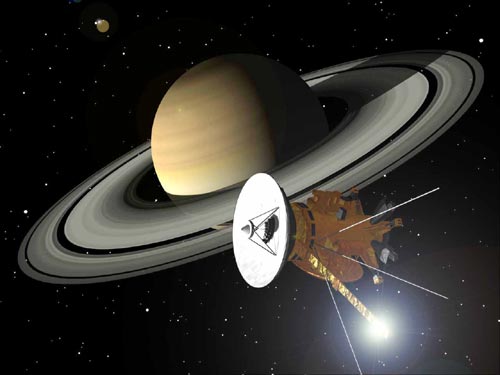
NASA's Voyager 2 space satellite was the first and as yet only spacecraft to visit Neptune on Aug. 25, 1989. The satellite discovered Neptune's rings and six of the planet's moons
After the discovery of Uranus, it was noticed that its orbit was not as it
should be in accordance with Newton's laws.
 It was therefore predicted that another more distant planet must be
perturbing Uranus' orbit. Neptune was
first observed by Galle
and d'Arrest on 1846 Sept 23
very near to the locations independently predicted by
Adams and
Le Verrier
from calculations based on the observed
positions of Jupiter,
Saturn and Uranus.
An international dispute arose between the English and French
(though not, apparently between Adams and Le Verrier personally) over priority
and the right to name the new planet;
they are now jointly credited with Neptune's discovery.
Subsequent observations have shown
that the orbits calculated by Adams and Le Verrier diverge from Neptune's
actual orbit fairly quickly. Had the search for the planet taken place a few
years earlier or later it would not have been found anywhere near the predicted
location.
It was therefore predicted that another more distant planet must be
perturbing Uranus' orbit. Neptune was
first observed by Galle
and d'Arrest on 1846 Sept 23
very near to the locations independently predicted by
Adams and
Le Verrier
from calculations based on the observed
positions of Jupiter,
Saturn and Uranus.
An international dispute arose between the English and French
(though not, apparently between Adams and Le Verrier personally) over priority
and the right to name the new planet;
they are now jointly credited with Neptune's discovery.
Subsequent observations have shown
that the orbits calculated by Adams and Le Verrier diverge from Neptune's
actual orbit fairly quickly. Had the search for the planet taken place a few
years earlier or later it would not have been found anywhere near the predicted
location.
More than two centuries earlier, in 1613, Galileo observed Neptune when it happened to be very near Jupiter, but he thought it was just a star. On two successive nights he actually noticed that it moved slightly with respect to another nearby star. But on the subsequent nights it was out of his field of view. Had he seen it on the previous few nights Neptune's motion would have been obvious to him. But, alas, cloudy skies prevented obsevations on those few critical days.
Read more about Neptune l Neptune facts, pictures and information. by nineplanets.org
After the discovery of Uranus, it was noticed that its orbit was not as it should be in accordance with Newton's laws. It was therefore predicted that another more distant planet must be perturbing Uranus' orbit. Neptune was first observed by Galle and d'Arrest on 1846 Sept 23 very near to the locations independently predicted by Adams and Le Verrier from calculations based on the observed positions of Jupiter, Saturn and Uranus. An international dispute arose between the English and French (though not, apparently between Adams and Le Verrier personally) over priority and the right to name the new planet; they are now jointly credited with Neptune's discovery. Subsequent observations have shown that the orbits calculated by Adams and Le Verrier diverge from Neptune's actual orbit fairly quickly. Had the search for the planet taken place a few years earlier or later it would not have been found anywhere near the predicted location.
More than two centuries earlier, in 1613, Galileo observed Neptune when it happened to be very near Jupiter, but he thought it was just a star. On two successive nights he actually noticed that it moved slightly with respect to another nearby star. But on the subsequent nights it was out of his field of view. Had he seen it on the previous few nights Neptune's motion would have been obvious to him. But, alas, cloudy skies prevented obsevations on those few critical days.
Physical Characteristics :
Neptune’s cloud cover has an especially vivid blue tint that is partly due to an as-yet-unidentified compound and the result of the absorption of red light by methane in the planets mostly hydrogen-helium atmosphere. Photos of Neptune reveal a blue planet, and it is often dubbed an ice giant, since it possesses a thick, slushy fluid mix of water, ammonia and methane ices under its atmosphere and is roughly 17 times Earth's mass and nearly 58 times its volume. Neptune's rocky core alone is thought to be roughly equal to Earth's mass.
Despite its great distance from the sun, which means it gets little sunlight to help warm and drive its atmosphere, Neptune's winds can reach up to 1,500 miles per hour (2,400 kilometers per hour), the fastest detected yet in the solar system. These winds were linked with a large dark storm that Voyager 2 tracked in Neptune's southern hemisphere in 1989. This oval-shaped, counterclockwise-spinning "Great Dark Spot" was large enough to contain the entire Earth, and moved westward at nearly 750 miles per hour (1,200 kilometers per hour). This storm seemed to have vanished when the Hubble Space Telescope later searched for it. Hubble has also revealed the appearance and then fading of two other Great Dark Spots over the last decade.

( dark spot)
Orbital Characteristics :
Neptune is the eighth and most distant planet from the sun. Its elliptical, oval-shaped orbit makes it keep an average distance from the sun of almost 2.8 billion miles (4.5 billion kilometers), or roughly 30 times as far away as Earth, making it invisible to the naked eye. Neptune goes around the sun once roughly every 165 Earth years, and will complete its first orbit, since being discovered, in 2011.
Every 248 years, Pluto moves inside Neptune's orbit for 20 years or so, during which time it is closer to the sun than Neptune. Nevertheless, Neptune remains the farthest planet from the sun, since Pluto was reclassified as a dwarf planet in 2006.
Neptune’s Moons :
Neptune has 13 known moons, named after lesser sea gods and nymphs from Greek mythology, just as Neptune itself was named after the Roman god of the sea. The largest by far is Triton, whose discovery on Oct. 10, 1846 was in a sense enabled by beer — amateur astronomer William Lassell used the fortune he made as a brewer to finance his telescopes.
Triton is unique in being the only large moon in the solar system to circle its planet in a direction opposite to its planet's rotation — this "retrograde orbit" suggests that Triton may once have been a dwarf planet that Neptune captured rather than forming in place. Neptune's gravity is dragging Triton closer to the planet, meaning that millions of years from now, Triton will come close enough for gravitational forces to rip it apart.
Triton is extremely cold, with temperatures on its surface reaching about minus 391 degrees F (minus 235 degrees C), making it one of the coldest places in the solar system. Nevertheless, Voyager 2 detected geysers spewing icy matter upward more than 5 miles (8 kilometers), showing its interior appears warm. Recently, seasons have been discovered on Triton.
Triton is the only spherical moon of Neptune — the planet’s other twelve moons are irregularly shaped.
(Triton)
Rings of Neptune :
Neptune's unusual rings are not uniform, but possess bright thick clumps of dust called arcs. The rings are thought to be relatively young and short-lived. Earth-based observations announced in 2005 found that Neptune's rings are apparently far more unstable than previously thought, with some dwindling away rapidly. Neptune has six rings which circle the planet. Neptune's rings have been given names: the outermost is Adams (which contains three prominent arcs now named Liberty, Equality and Fraternity), next is an unnamed ring co-orbital with Galatea, then Leverrier (whose outer extensions are called Lassell and Arago) and finally the faint but broad Galle.
NASA's Voyager 2 space satellite was the first and as yet only spacecraft to visit Neptune on Aug. 25, 1989. The satellite discovered Neptune's rings and six of the planet's moons
It was therefore predicted that another more distant planet must be
perturbing Uranus' orbit. Neptune was
first observed by Galle
and d'Arrest on 1846 Sept 23
very near to the locations independently predicted by
Adams and
Le Verrier
from calculations based on the observed
positions of Jupiter,
Saturn and Uranus.
An international dispute arose between the English and French
(though not, apparently between Adams and Le Verrier personally) over priority
and the right to name the new planet;
they are now jointly credited with Neptune's discovery.
Subsequent observations have shown
that the orbits calculated by Adams and Le Verrier diverge from Neptune's
actual orbit fairly quickly. Had the search for the planet taken place a few
years earlier or later it would not have been found anywhere near the predicted
location.
More than two centuries earlier, in 1613, Galileo observed Neptune when it happened to be very near Jupiter, but he thought it was just a star. On two successive nights he actually noticed that it moved slightly with respect to another nearby star. But on the subsequent nights it was out of his field of view. Had he seen it on the previous few nights Neptune's motion would have been obvious to him. But, alas, cloudy skies prevented obsevations on those few critical days.
Read more about Neptune l Neptune facts, pictures and information. by nineplanets.org
In Roman mythology
Neptune
(Greek:
Poseidon)
was the god of the Sea.
Read more about Neptune l Neptune facts, pictures and information. by nineplanets.org
Read more about Neptune l Neptune facts, pictures and information. by nineplanets.org
In Roman mythology
Neptune
(Greek:
Poseidon)
was the god of the Sea.
Read more about Neptune l Neptune facts, pictures and information. by nineplanets.org
Read more about Neptune l Neptune facts, pictures and information. by nineplanets.org